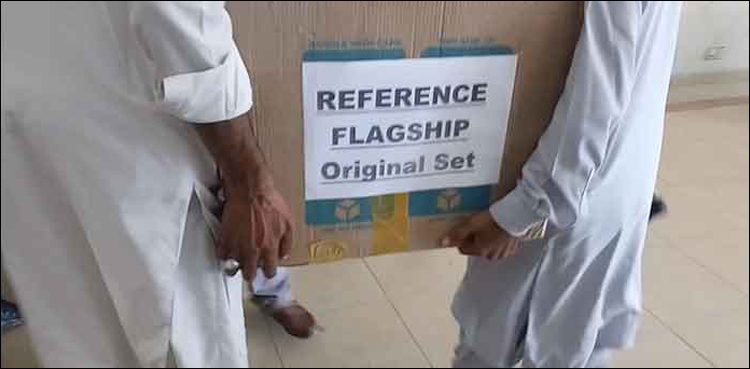
Nawaz acquitted on ‘benefit of doubt’ in Flagship reference: detailed verdict

ISLAMABAD: The accountability court has issued a detailed verdict in the Flagship Investment corruption reference, according to which former premier Nawaz Sharif was acquitted on the basis of ‘benefit of doubt’.

According to the verdict released today, there were not enough evidences in the case to convict the supreme leader of Pakistan Muslim League – Nawaz.

Sources informed that the verdict, which is 69-pager, notes that the documents presented by the National Accountability Bureau (NAB) were also incomplete.

The NAB on Dec 24 decided to challenge Nawaz Sharif’s acquittal in Flagship corruption reference.

Already disqualified for holding public office, Nawaz Sharif was acquitted of all charges in the Flagship Investment case owing to lack of evidences, thus he has been acquitted, the short verdict of the accountability court read.

On December 24, an accountability court announced the verdict in two National Accountability Bureau’s references namely Al-Azizia Steel Mill and Flagship Investment and punished Nawaz to seven years in prison and ordered him to pay $25million and Rs1.5 billion as fine. However, he was acquitted of all charges in the Flagship Investment case.

As per sources, the legal team of the PML-N leader is also gearing up to challenge the verdict of Al-Azizia reference against Nawaz.

Detailed judgement of accountability court in Al-Azizia reference case

The post Nawaz acquitted on ‘benefit of doubt’ in Flagship reference: detailed verdict appeared first on ARYNEWS.


from ARYNEWS http://bit.ly/2RnA3gr

Comments

Popular posts from this blog

Rouhani calls Imran, discusses resumption of trade

ISLAMABAD: Pakistan and Iran on Wednesday discussed full resumption of bilateral trade, which was halted last month because of the Covid-19 pandemic. “The two sides stressed the need to reactivate borders and border markets and strengthen trade ties by following health guidelines,” a statement issued by the Iranian presidency on the telephonic conversation between Prime Minister Imran Khan and President Dr Hassan Rouhani said. President Rouhani had called the prime minister for Ramazan greetings. Border trade between the two countries was suspended after a meeting of the National Security Committee (NSC), held on March 13, decided to close all borders because of the pandemic. Islamabad partially relaxed the restrictions on April 21, allowing the import of certain food items and provision of petrol and diesel to the border areas. Cargo traffic from Iran was allowed for three days every week. Cargo movement between the two countries takes place through five border crossings — Taftan...

Today’s outlook: Sindh CM discusses reopening markets with PM Khan

Here are some of the stories we are expecting to follow today (Thursday): Sindh Chief Minister Murad Ali Shah will take Prime Minister Imran Khan into confidence over reopening shops and markets across the province. The reopened markets will have to follow SOPs. Sindh Transport Minister Awais Qadir Shah will discuss SOPs with transporters for resuming public transport in the coming days. The meeting will be held at the Sindh Assembly building at 1:30pm. The Oil and Gas Regulatory Authority has proposed a price cut of Rs20.68 per litre for petrol in its summary. Imam-e-Kaaba Sheikh Abdul Rahman Al-Sudais has said Masjid Al Haram and Masjid Al Nabawi will be reopened for worshipers soon. He said the Kaaba is being sterilised using latest technologies. Punjab Chief Minister Usman Buzdar will head various meetings during his visit to Bahawalpur. As of Thursday, Pakistan has reported more than 15,500 confirmed coronavirus cases. ICYMI: An amendment to the National Accountability Or...

If Pakistani elderly self-distance infections could drop 30%: study

If we do nothing, COVID-19 could infect 206 million Pakistanis and kill 691,000. This is the estimation of researchers from the Imperial College London COVID-19 Response Team who have published country-wise projections in a March 26 report ‘ The Global Impact of COVID-19 and Strategies for Mitigation and Suppression ’ Furthermore, using an infection fatality rate from China, this means 4.4 million Pakistanis would require hospitalisation and from among those, 917,000 individuals would require critical care. Pakistan has a population of 220 million people. The research is based on the infection fatality rate from China, country health care system capacities and that one person with coronavirus is likely to infect 3 others. (You can find the excel sheet with Pakistan numbers here: Imperial-College-COVID19-Global-unmitigated-mitigated-suppression-scenarios.xlsx ) Forty-seven researchers crunched the numbers and made these projections to give countries, including Pakistan, some idea of...