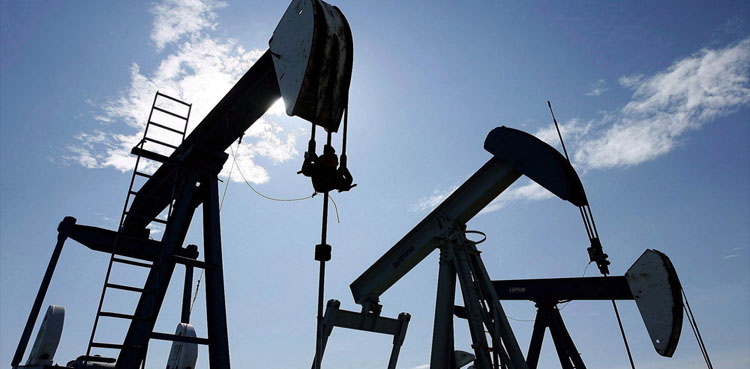
Oil falls, heading for biggest monthly slide since 2008

oil prices, biggest fall, 2008

LONDON: Oil fell on Thursday, bringing losses for the month so far to 23 percent, marking its largest one-month fall since the depths of the financial crisis in 2008.

A seemingly relentless rise in U.S. crude supply, together with Saudi Arabia’s insistence that it will not cut output on its own to stabilize the market, wiped out overnight gains in oil futures.

Brent crude futures LCOc1 fell 64 cents on the day to $58.12 a barrel, off an earlier session high of $59.51, while U.S. crude futures CLc1 dropped below $50 for the first time in over a year. The January contract was last down 40 cents at $49.89.

“I’m surprised and yet not surprised about the move lower this morning,” PVM Oil Associates analyst Tamas Varga said.

“I’m surprised because stock markets rallied yesterday, because the dollar weakened and that should provide some sort of support for oil, but at the same time, I’m not surprised because the Saudi energy minister said yesterday they won’t be the only one to cut (output) and even Putin has said he’s happy with oil prices at $60.”

Russian President Vladimir Putin, whose country is the world’s second biggest oil producer, said on Wednesday he was in touch with OPEC and ready to continue cooperation on supply if needed, but he was satisfied with an oil price of $60.

The Organization of the Petroleum Exporting Countries (OPEC) and non-OPEC producers meet in Vienna next week to discuss a new round of supply cuts of 1 million to 1.4 million barrels per day (bpd) and possibly more to prop up prices.

U.S. crude inventories have hit their highest in a year after a tenth consecutive weekly increase, and are now only 80 million barrels below March 2017’s record 535 million barrels, according to the Energy Information Administration. [EIA/S]

“WTI oil is now trading right around the $50 per barrel level, a price last seen well over a year ago, as the current oversupply situation has now manifested itself in 10 consecutive weekly increases in U.S. oil inventories,” said William O’Loughlin, Investment Analyst at Australia’s Rivkin Securities.

“We have seen huge increases in supply and the demand picture is in question. However, we might see some movement on global trade issues at the G20 meeting which starts on Friday,” said Michael McCarthy, chief strategist at CMC Markets and Stockbroking.

Investors in commodity markets are looking ahead to the meeting of leaders of the Group of 20 nations (G20), the world’s biggest economies, on Nov. 30 and Dec. 1, with the U.S.-China trade war a key focus.

The post Oil falls, heading for biggest monthly slide since 2008 appeared first on ARYNEWS.


from ARYNEWS https://ift.tt/2KG82eo

Comments

Popular posts from this blog

Today’s outlook: Sindh CM discusses reopening markets with PM Khan

Here are some of the stories we are expecting to follow today (Thursday): Sindh Chief Minister Murad Ali Shah will take Prime Minister Imran Khan into confidence over reopening shops and markets across the province. The reopened markets will have to follow SOPs. Sindh Transport Minister Awais Qadir Shah will discuss SOPs with transporters for resuming public transport in the coming days. The meeting will be held at the Sindh Assembly building at 1:30pm. The Oil and Gas Regulatory Authority has proposed a price cut of Rs20.68 per litre for petrol in its summary. Imam-e-Kaaba Sheikh Abdul Rahman Al-Sudais has said Masjid Al Haram and Masjid Al Nabawi will be reopened for worshipers soon. He said the Kaaba is being sterilised using latest technologies. Punjab Chief Minister Usman Buzdar will head various meetings during his visit to Bahawalpur. As of Thursday, Pakistan has reported more than 15,500 confirmed coronavirus cases. ICYMI: An amendment to the National Accountability Or...

Today’s outlook: Federal Cabinet discusses COVID-19, Islamabad eases lockdown

Here are some of the news stories we are expecting to follow today (Tuesday): Prime Minister Imran Khan will chair a meeting of the Federal Cabinet in Islamabad to discuss the current situation in the country because of the novel coronavirus. The Cabinet will approve decisions made in the last Economic Coordination Committee meeting along with a relief package for journalists. The Islamabad High Court will hear a case pertaining to giving relief to textile mills in paying their electricity bills. The court had asked the mill owners to ensure a guarantee that they’ll not lay off any daily wage worker. The Sindh government has resumed operations of 153 more factories. They have directed them to follow all SOPs. The Islamabad administration has eased the lockdown. Hiking trails and parks across the federal capital have been reopened for the public. Sindh Governor Imran Ismail has tested positive for the novel coronavirus. He is the second politician from Sindh, after Education Minis...

Rouhani calls Imran, discusses resumption of trade

ISLAMABAD: Pakistan and Iran on Wednesday discussed full resumption of bilateral trade, which was halted last month because of the Covid-19 pandemic. “The two sides stressed the need to reactivate borders and border markets and strengthen trade ties by following health guidelines,” a statement issued by the Iranian presidency on the telephonic conversation between Prime Minister Imran Khan and President Dr Hassan Rouhani said. President Rouhani had called the prime minister for Ramazan greetings. Border trade between the two countries was suspended after a meeting of the National Security Committee (NSC), held on March 13, decided to close all borders because of the pandemic. Islamabad partially relaxed the restrictions on April 21, allowing the import of certain food items and provision of petrol and diesel to the border areas. Cargo traffic from Iran was allowed for three days every week. Cargo movement between the two countries takes place through five border crossings — Taftan...